
The Agentic Micro-Manager: What Gets Lost When You Approve Every Step
Approving every step an agent takes feels like the responsible choice. It's actually a named failure mode with costs that compound: throughput capped at your attention, a gate that never earns its way open, and a reviewer who quietly stops reviewing.


Part 2 of the Managing Agents Like People series. New to the series? Start with Part 1: Managing Agents Is Like Managing People.
Approving Every Step Is a Failure Mode, Not Extra Diligence
In Managing Agents Is Like Managing People, I argued that the instinct to review everything an agent does undermines the reason for delegating to it. This post takes that instinct seriously enough to give it a name, because it deserves one: the agentic micro-manager.
The pattern looks like this. An agent is set up to handle vendor invoices. It proposes reading the inbox, and someone clicks approve. It proposes extracting the invoice total, and someone clicks approve. Then it looks up the purchase order, flags a mismatch, drafts a note to the vendor, and updates the accounting record, with a human approval at every step. Each click feels like responsibility. Nobody gets fired for checking.
But this isn't just a slower version of good oversight. It's a distinct failure mode, and its costs don't stay flat. They compound. None of this is an argument against human review, which genuinely matters. It's an argument about where that review gets spent.
Your Agent's Throughput Becomes Your Calendar
The practical value of an agent is speed and parallelism. It can work through forty support tickets while you're in a meeting, or reconcile a month of invoices overnight. That's the whole reason to hand it the work.
Put a human approval on every step and the agent runs at exactly the speed of the human's attention. When you're in that meeting, it sits idle, waiting on a click. When you're out for the afternoon, the queue backs up behind you. You've taken a system designed to remove a bottleneck and installed yourself as the bottleneck, with the added overhead of switching context every few minutes to approve something you weren't thinking about.
At that point the honest question is whether the agent is doing the work or just narrating it to you one step at a time. If the answer is the second one, you're paying for automation and getting a very detailed to-do list.
A Gate That Never Opens Produces No Evidence
The less obvious cost is that step-by-step approval prevents trust from ever being earned.
Think about how trust grows with a new hire. It isn't granted on a schedule. It builds from a record of work they did well when you weren't standing over them: the report that came back right, the customer issue they handled sensibly, the odd number they caught and flagged on their own. That record is what lets a manager say, with a straight face, that it's time to give this person more rope.
An agent gated on every step can never build that record. Every good outcome is co-authored by your approval, so you can't tell whether the agent would have gotten it right on its own. Six months in, you still have no evidence of its unsupervised judgment, because you never let it exercise any. "It's been fine" is true, but you can't say whether it's been fine because of the agent or because of you.
So the gate justifies itself. There's never a defensible moment to loosen it, because loosening it is the only thing that would produce the evidence you'd need to justify loosening it. Micromanagement, with agents as with people, is self-perpetuating. The alternative is to keep a deliberate evidence trail at the outcome level: what the agent completed, what it flagged, where it was wrong and how you found out. That trail only fills up when there's something to observe besides your own approvals. I'll come back to what it looks like to keep one properly in a later post.
Review Fatigue Turns Approval Into a Rubber Stamp
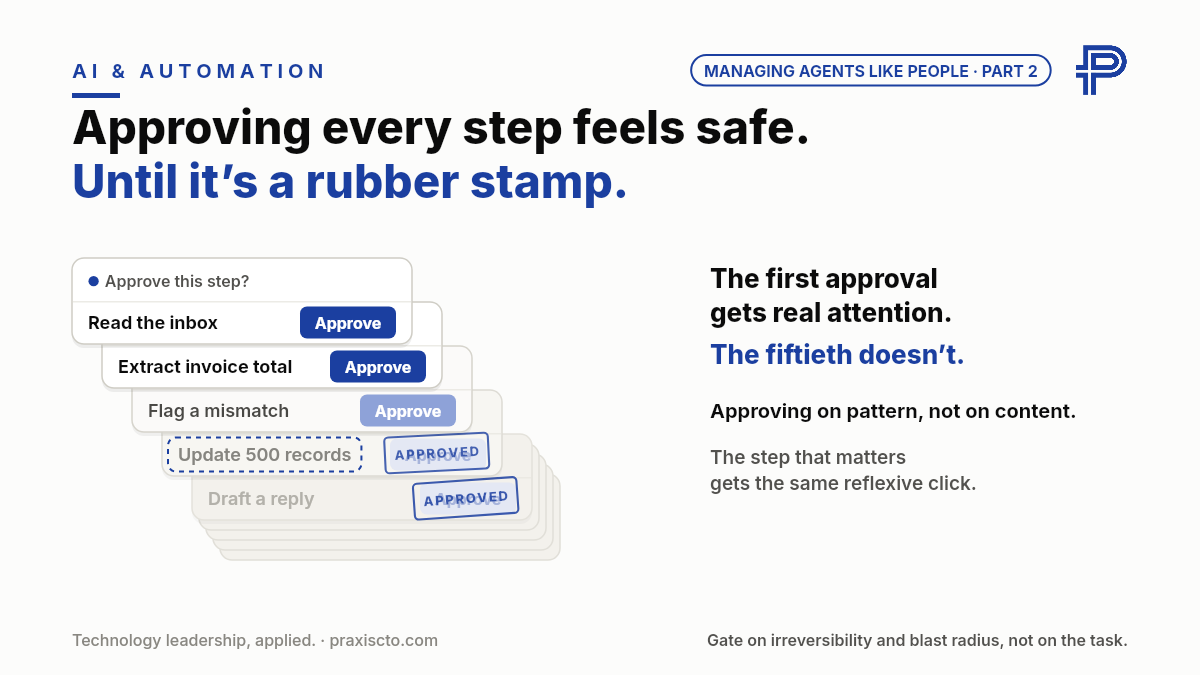
Here's where micromanagement marketed as safety quietly becomes its opposite.
The first approval of the day gets real attention. The fiftieth doesn't. Most of the steps an agent proposes are routine, and most of them are fine, so attention learns that approving is safe. Requests start to look alike. The reviewer starts approving on pattern instead of on content, reading the first line and clicking through.
Then the one step that actually matters arrives, the email going to the wrong customer or the record update that overwrites the wrong field, and it looks exactly like the forty-nine before it. It gets the same reflexive click.
A rubber stamp is worse than no gate at all, because it leaves a record saying someone reviewed this. The organization believes it has human oversight. What it actually has is a human's name attached to decisions they didn't really examine. That's an accountability problem as much as a safety one: the person approving owns those outcomes whether or not they were paying attention.
A slower, outcome-level review, done at fewer points with real attention, is safer than a fast approval on every step. Fewer reviews, each one real, beats many reviews, each one a click.
An Agent Can't Quit, So the Cost Lands on You
The people-management mirror here is instructive, partly because of where it breaks.
A human direct report who needs approval on every keystroke reacts. They stop thinking for themselves and wait to be told. They disengage. Eventually they leave, and that departure is a signal loud enough that most managers eventually hear it. The cost of micromanaging a person is visible because the person makes it visible.
An agent doesn't react. It doesn't get demoralized, doesn't push back, and can't quit. It will wait for your approval indefinitely and never complain. That sounds like an advantage, and it removes the feedback that would normally tell a manager something is wrong. The cost still exists. It just shows up somewhere quieter: in a manager who is exhausted from approving things all day, and in an agent running at a fraction of what it could do.
There's a subtler cost too. When a human approves every step, the human becomes the agent's judgment. The instructions never have to get better, the escalation rules never have to be written down, and the scope never has to be defined clearly, because the approver is covering for all of it in real time. Remove the approver later and you discover the agent was never set up to work without one.
Gate on Irreversibility and Blast Radius, Not on the Task
The fix isn't to remove oversight. It's to place it where it does work.
Most micromanagement is gated on task identity: "this is the agent that handles customer email, so everything it does gets approved." The better question is about the individual action. How hard is it to undo, and how much damage could it do if it's wrong?
Applied to the email agent, that looks different. Reading the inbox and drafting a reply are reversible and contained, so they run without a gate. Sending the reply to a customer is external and can't be recalled, so it keeps a human approval, at least until there's a track record. Updating a single internal CRM note can run freely with spot checks. A bulk change to five hundred records gets a gate, because one mistake becomes five hundred.
Alongside the approval gates, write down hard boundaries that only fire when they're crossed: never touch production data, never send to an address outside the existing customer list, never commit money above a set amount. Those boundaries cost nothing on the ninety-nine normal runs and earn their keep on the hundredth.
Then review outcomes on a cadence instead of watching every motion. Sample completed work and read it properly. Look at what the agent flagged and whether it should have. Loosen deliberately as the evidence builds, and tighten quickly when something goes wrong.
Human Review Is Too Valuable to Spend on Every Step
None of this makes the case for hands-off agents. Human review genuinely matters. Accountability for what an agent does stays with the people who deployed it, and there are actions that should keep a human signature on them no matter how good the track record gets.
That's precisely why it shouldn't be spent on every step. Attention is the scarce resource in agent oversight. Spread it across every tool call and it thins out until it isn't really there. Concentrate it on the actions that are irreversible or far-reaching, and on honest review of results, and it does what oversight is supposed to do. The goal isn't less oversight. It's oversight that's actually paying attention, and that leaves room for trust to be earned.
Subscribe for more like this.
In the spirit of this site: this article was drafted with AI assistance and edited by Matt before publishing — the same kind of human-in-the-loop review this piece argues for.
About the Author: Matt Shirel writes Praxis CTO, exploring what real technology leadership looks like for growing companies that have outgrown ad hoc decision-making. He brings over 20 years in enterprise IT — spanning infrastructure architecture, cloud strategy, and technology budget ownership — and works hands-on in applied AI, building multi-agent and RAG workflows with tools like n8n and AI coding agents — work where deciding which steps actually deserve a human approval is a design choice, not a theory.